
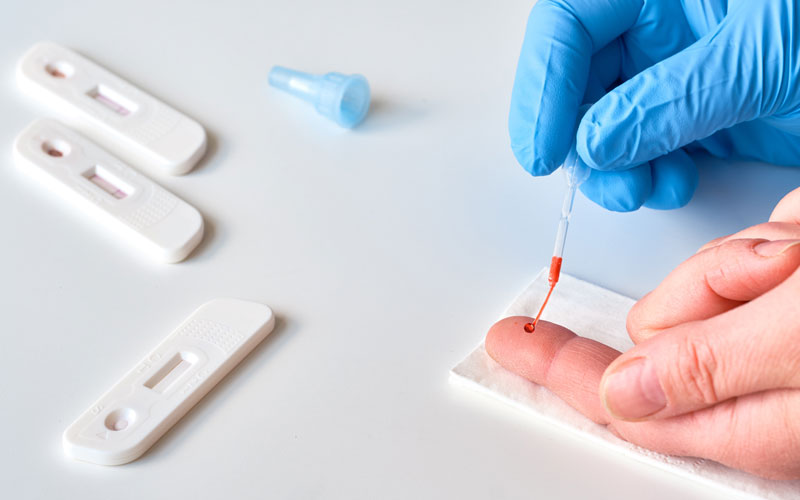
Blood testing can happen at home with a mailed kit or in a clinic with a professional draw. Both rely on a laboratory to analyze the sample—what differs is how the sample is collected, the range of tests available, and how much direct supervision you get. Understanding those differences makes it easier to pick the approach that fits a given test and your situation.
What Is At-Home Blood Testing?
At-home testing means receiving a kit, collecting a small sample yourself—often via finger prick—and mailing it to a laboratory, with results delivered to an online portal. Kits include collection tools, instructions, and prepaid return packaging.
The main advantages are convenience and flexibility: no appointment, travel, or waiting room, which helps people with busy schedules, limited mobility, or long distances to a lab. It can also make repeat monitoring of a few markers easier and more private.
There are trade-offs. Self-collected finger-prick samples depend on good technique, so a mistake during collection can affect results. And not every test can be done from a finger-prick sample. One thing that should not change is lab quality: the laboratory analyzing an at-home sample should still be CLIA-certified, the federal standard (overseen by CMS) for accurate, reliable testing.
What Is In-Clinic Blood Testing?
In-clinic testing takes place at a healthcare facility or laboratory, where a trained professional draws blood—usually from a vein in the arm. A venous draw supports a wider range of panels and reduces the chance of collection error.
When weighing the two approaches, people usually compare:
- Convenience and scheduling
- The type of sample a test requires
- The range of tests available
- Professional supervision during collection
Convenience tends to favor at-home testing. The required sample type can be decisive, since some tests need venous blood rather than a finger prick. In-clinic settings typically offer a broader menu of specialized tests, and having a professional collect the sample can add reassurance and reduce collection problems.
A Word on Accuracy and Interpretation
Regardless of setting, a result is a measurement that still needs interpretation. Reference ranges can vary between labs, and a value outside the range isn't automatically a problem. The FDA stresses that consumer tests are not a substitute for a healthcare evaluation and shouldn't be used to start, stop, or change treatment on your own. If an at-home result looks surprising or concerning, the right next step is to confirm and discuss it with a provider rather than act on it immediately.
Making an Informed Choice
The best option depends on the specific test, your comfort level, how often you plan to test, and any guidance from your provider. For routine monitoring of a few markers, at-home testing can be convenient; for broader or more complex evaluations—or anything tied to symptoms—an in-clinic draw coordinated with a clinician is often the better fit.
If you're comparing options, TreatmentsWise offers service reviews and articles to help you decide. Plan to review whatever you order with a licensed healthcare provider.
Compare TreatmentsSources used for medical context
- CMS for CLIA laboratory certification standards.
- U.S. FDA for the limits of direct-to-consumer tests.
- MedlinePlus for how reference ranges and follow-up work.