
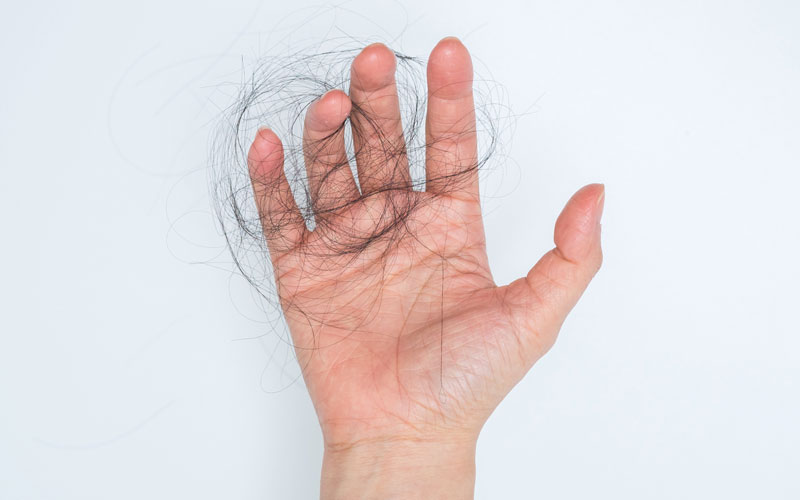
If you strip away the marketing, treating hair loss comes down to two medications with FDA approval and decades of study behind them: finasteride and minoxidil. Understanding how each one works — and what the clinical trials actually showed — makes it much easier to choose a treatment and judge whether it's working for you.
This guide explains the biology of pattern hair loss, the mechanism and evidence for each medication, what combination treatment adds, and the honest timeline you should expect.
Why Pattern Hair Loss Happens
The most common form of hair loss in both men and women is androgenetic alopecia — pattern hair loss. In people with a genetic susceptibility, a hormone called dihydrotestosterone (DHT) binds to receptors in scalp follicles and gradually miniaturizes them. Each growth cycle produces a slightly finer, shorter hair, until eventually the follicle stops producing a visible strand at all.
Not all hair loss works this way. Stress, illness, thyroid disorders, low iron, and conditions like alopecia areata cause shedding through different mechanisms — and the treatments discussed here are not designed for those. That's why a clinician should confirm that pattern hair loss is actually what you have before you start treatment.
The Hair Growth Cycle in Brief
Each follicle cycles through three phases:
- Anagen (growth): the active growing phase, which normally lasts years
- Catagen (transition): a brief shutdown phase
- Telogen (resting): the hair rests, then sheds as a new one starts beneath it
In pattern hair loss, DHT progressively shortens the anagen phase, so hairs spend less time growing and more time resting. The two approved medications attack this from opposite directions: one reduces the DHT signal, the other pushes follicles back toward growth.
Finasteride: Lowering the DHT Signal
Oral finasteride (1 mg daily) is FDA-approved for male pattern hair loss — in men only. It inhibits 5-alpha-reductase, the enzyme that converts testosterone into DHT, substantially lowering DHT levels in the scalp and blood.
The evidence is strong. In clinical studies, improvement was visible as early as three months, and over five years finasteride consistently slowed progression compared with placebo. Published reviews report that it reduces further hair loss in roughly 8 to 9 men in 10 and produces some regrowth in about two-thirds.
The trade-offs are real, too: a small percentage of men in trials reported decreased libido, erectile dysfunction, or ejaculation problems, which usually — though not always — resolve after stopping. And finasteride is contraindicated in women who are or may become pregnant because it can cause abnormalities in a male fetus. A 12-month trial in postmenopausal women also found the standard dose ineffective, which is why it remains a men's medication.
Topical finasteride, offered by many telehealth providers as a compounded spray, is not FDA-approved. Some studies suggest comparable benefit to the pill, but the FDA has cautioned that it is absorbed through the skin and can cause the same systemic side effects.
Minoxidil: Pushing Follicles Back Into Growth
Topical minoxidil is FDA-approved for both men and women and is available without a prescription. Originally a blood-pressure drug, it was approved for hair loss in 1988 after patients kept growing hair on it. It works by stimulating follicles and extending the anagen growth phase; improved blood flow around the follicle is thought to play a role.
The original studies set realistic expectations: with the 2% solution, about 26% of men reported moderate-to-dense regrowth after four months, versus 11% on placebo — meaningful for many users, but not a full restoration, and frontal hairline regrowth was not demonstrated. In women, both 2% and 5% strengths beat placebo in a 48-week randomized trial.
Oral minoxidil in low doses is prescribed off-label for hair loss. A 2024 randomized trial found 5 mg daily performed about as well as 5% topical in men over 24 weeks. It's an option for people who can't tolerate the topical version, but it can cause unwanted body-hair growth, fluid retention, and heart-rate changes, so it requires clinician supervision.
Why Combining Them Often Works Better
Because finasteride reduces the hormonal signal driving miniaturization while minoxidil stimulates growth directly, they complement each other. Studies have found that combining oral finasteride with topical minoxidil produces better results than either medication alone, which is why many clinicians recommend the pair for men with moderate thinning. The combination products sold as single sprays are compounded — convenient, but not FDA-approved as combined formulations.
The Honest Timeline
- Weeks 2–8: A temporary increase in shedding with minoxidil is common — follicles are cycling old hairs out to restart growth.
- Months 3–4: Shedding typically slows; the earliest visible improvement in studies appeared around month three.
- Months 6–12: The window dermatologists recommend before judging whether a treatment works for you.
- After stopping: Benefits reverse. Shedding typically resumes within weeks of stopping finasteride, and hair gained during treatment is generally lost within about a year. Minoxidil gains fade over several months. These are maintenance medications, not cures.
The Bottom Line
Finasteride and minoxidil work through well-understood mechanisms, and both have trial data showing they slow loss and regrow some hair for many — not all — people who use them consistently. Anything promising dramatic regrowth, overnight results, or a permanent fix is not supported by the evidence.
A sensible path: have a clinician confirm that pattern hair loss is the cause, pick the approved treatment (or combination) that fits your situation, commit to six to twelve months before judging, and plan for ongoing use if it works.
Sources used for medical context
- NIH StatPearls: 5-Alpha-Reductase Inhibitors for finasteride's mechanism, efficacy rates, combination-therapy evidence, and reversal after discontinuation.
- FDA prescribing information for finasteride (Propecia) for clinical trial results, side effects, and the pregnancy contraindication.
- JAMA Dermatology: oral vs topical minoxidil randomized trial for minoxidil's history, approval status, and oral-dose findings.
- Journal of the AAD: trial of 5% and 2% topical minoxidil in women for efficacy in female pattern hair loss.